https://en.m.wikipedia.org/wiki/Chinese_gods_and_immortals
Besides Shàngdì and Tàidì, other names include Yudi (“Jade Deity”) and Taiyi (“Great Oneness”) who, in mythical imagery, holds the ladle of the Big Dipper (Great Chariot), providing the movement of life to the world.[23] As the hub of the skies, the north celestial pole constellations are known, among various names, as Tiānmén (天門, “Gate of Heaven”)[24] and Tiānshū (天樞, “Pivot of Heaven”).[25]
Other names of the God of Heaven are attested in the vast Chinese religio-philosophical literary tradition:
Tiāndì (天帝), “Deity of Heaven” or “Emperor of Heaven”:[26] “On Rectification” (Zheng lun) of the Xunzi uses this term to refer to the active God of Heaven setting creation in motion.[20]
Tianzhu (天主), the “Lord of Heaven”: In “The Document of Offering Sacrifices to Heaven and Earth on the Mountain Tai” (Fengshan shu) of the Records of the Grand Historian, it is used as the title of the first God from whom all the other gods derive.[27]
Tiānhuáng (天皇), the “August Personage of Heaven”: In the “Poem of Fathoming Profundity” (Si’xuan fu), transcribed in “The History of the Later Han Dynasty” (Hou Han shu), Zhang Heng ornately writes: «I ask the superintendent of the Heavenly Gate to open the door and let me visit the King of Heaven at the Jade Palace».[26]
Tianwang (天王), the “King of Heaven” or “Monarch of Heaven”.
Tiāngōng (天公), the “Duke of Heaven” or “General of Heaven”.[28]
Tiānjūn (天君), the “Prince of Heaven” or “Lord of Heaven”.[28]
Tiānzūn (天尊), the “Heavenly Venerable”, also a title for high gods in Taoist theologies.[26]
Tiānshén (天神), the “God of Heaven”, interpreted in the Shuowen Jiezi as “the being that gives birth to all things”.[20]
Shénhuáng (神皇), “God the August”, attested in Taihong (“The Origin of Vital Breath”).[20]
Lǎotiānyé (老天爺), the “Olden Heavenly Father”.[26]
Tian is both transcendent and immanent, manifesting in the three forms of dominance, destiny, and nature of things. In the Wujing yiyi (五經異義, “Different Meanings in the Five Classics”), Xu Shen explains that the designation of Heaven is quintuple:[27]
Huáng Tiān (皇天), “August Heaven” or “Imperial Heaven”, when it is venerated as the lord of creation.
Hào Tiān (昊天), “Vast Heaven”, with regard to the vastness of its vital breath (qi).
Mín Tiān (旻天), “Compassionate Heaven”, for it hears and corresponds with justice to the all-under-Heaven.
Shàng Tiān (上天), “Highest Heaven” or “First Heaven”, for it is the primordial being supervising all-under-Heaven.
Cāng Tiān (蒼天), “Deep-Green Heaven”, for it being unfathomably deep.
All these designations reflect a hierarchical, multiperspective experience of divinity.[17]
Though there is a massive underground church in Communist China, we often look at its religious roots as being based on Confucianism, a philosophical approach to harmonizing life, family, religion, culture, and politics that developed around 550 BC.
However, in an article for Christianity Today, Jixun Hu, who pastors East Bergen Christian Church in New Jersey, writes that China’s earliest religious roots have many parallels to Judaism. This includes the discovery of ancient bronze vessels which depicted the sacrifices of oxen and sheep thousands of years ago, similar to what we find in the Old Testament.
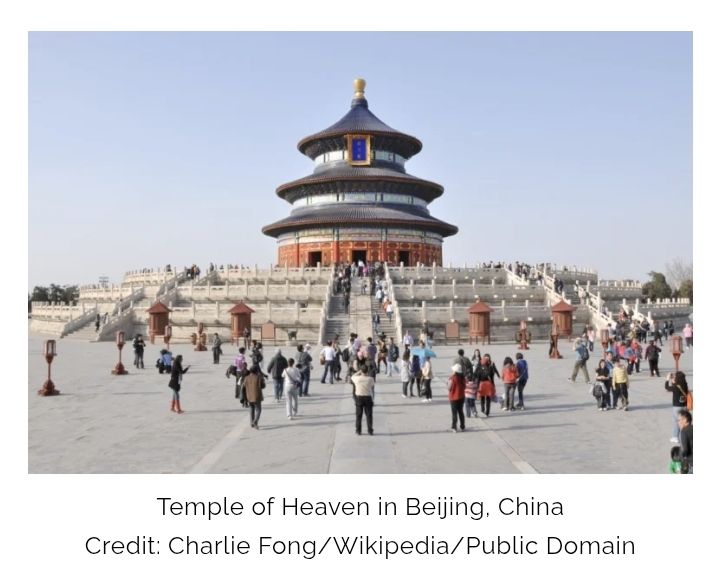
But in particular, Hu cited an incident that took place during a great drought in 1585, when Emperor Wanli of the Ming dynasty went to the Temple of Heaven to pray for rain.
Prior to going to the temple to pray to the ‘God of the Highest Heaven’, Emperor Wanli and his officials fasted for three days (see Esther 4:16). Once they were at the temple, Wanli prostrated himself before the ‘God of the Highest Heaven’ and confessed his failures, prayed, and offered animal sacrifices and incense to the God of the Highest Heaven.
The failures that Wanli expressed were noted in a speech he delivered to his officials while at the Temple of Heaven. In it, he stated that the country was being judged for the government corruption that was taking advantage of the common people, and believed they, including himself, were responsible for this.
However, during his speech, the emperor also used a particular phrase, the ‘God of the Highest Heaven’, “(皇天上帝, huang tian shang di)” to refer to God, a term that many modern Chinese Bible translations use today to refer to God.
And what caught Hu’s attention was a song of praise that Emperor Wanli and his group sang to ‘God of the Highest Heaven’ while at the temple.
Jehovah in Ancient China?
 For God, Truth and Meaning
Leave a comment