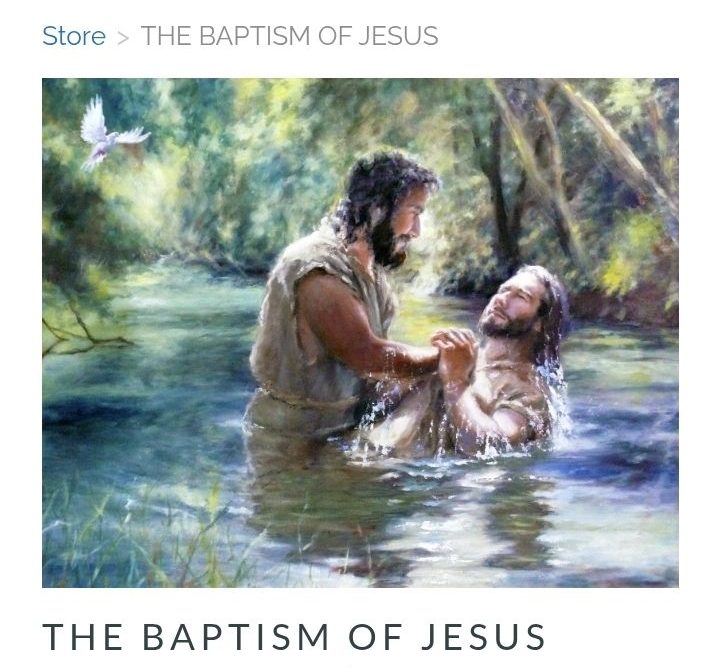
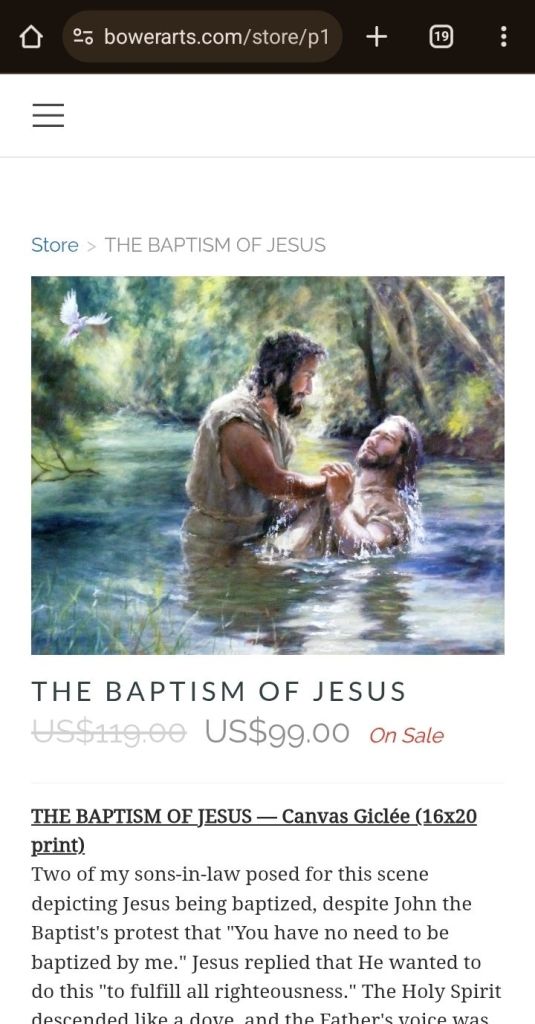
“The Baptism of Jesus
13 Then Jesus came from Galilee to the Jordan to be baptized by John.
14 But John tried to deter him, saying, “I need to be baptized by you, and do you come to me?”
15 Jesus replied, “Let it be so now; it is proper for us to do this to fulfill all righteousness.” Then John consented.
16 As soon as Jesus was baptized, he went up out of the water. At that moment heaven was opened, and he saw the Spirit of God descending like a dove and alighting on him.
17 And a voice from heaven said, “This is my Son, whom I love; with him I am well pleased.”” https://www.biblegateway.com/passage/?search=Matthew%203%3A13-17&version=NIV#:~:text=The%20Baptism%20of,am%20well%20pleased.%E2%80%9D
The History of Redemption
The Gospels set the baptism of Jesus in the context of the age-long unfolding of the history of redemption, which takes place according to the plan of God. The background of this history is found in Genesis 1–3, in the events of creation and the fall. The fall of Adam is followed by the first promise of redemption, found in Genesis 3:15, the promise of “her offspring,” the offspring of the woman, which already points to Christ (Gal 3:16).
John the Baptist explains his baptism as “a baptism of repentance for the forgiveness of sins” (Mark 1:4). His central message is, “Repent, for the kingdom of heaven is at hand” (Matt 3:2). The call to repentance is spread all the way across the pages of the Old Testament, because human sin dishonors God, renders us guilty, and breaks fellowship with the God who made us. Repentance on the part of man is necessary, but also atonement in order to deal with the guilt of sin. In the Old Testament, the necessity for atonement is symbolized by animal sacrifices, which depict the removal sin through the death of an innocent substitute. These sacrifices prefigure the coming of Christ as the final atoning substitute. John says, “Behold the Lamb of God, who takes away the sin of the world!” (John 1:29; compare verse 36). The Old Testament also describes ceremonies that use water as a symbol for washing and cleansing from sin: Leviticus 1:9; 8:6; 11:32; 15:5–33. These ceremonies point forward to Christ, whose blood cleanses us (Heb 9:12–22). John uses water in baptism, thereby signifying cleansing and the forgiveness of sins.
God called John the Baptist to serve as the forerunner of the Messiah: “I baptize you with water for repentance, but he who is coming after me is mightier than I, whose sandals I am not worthy to carry. He will baptize you with the Holy Spirit and fire” (Matt 3:11). The Gospels indicate that John is the fulfillment of the prophecies in Isaiah 40:3 and Malachi 3:1 concerning a prophetic forerunner (Matt 3:3; Mark 1:2–3). John proclaims that “the kingdom of heaven is at hand” (Matt 3:2).
https://www.thegospelcoalition.org/essay/the-baptism-of-jesus/
 For God, Truth and Meaning
Leave a comment