https://lawgazette.com.sg/feature/the-role-of-prosecutors-as-ministers-of-justice/
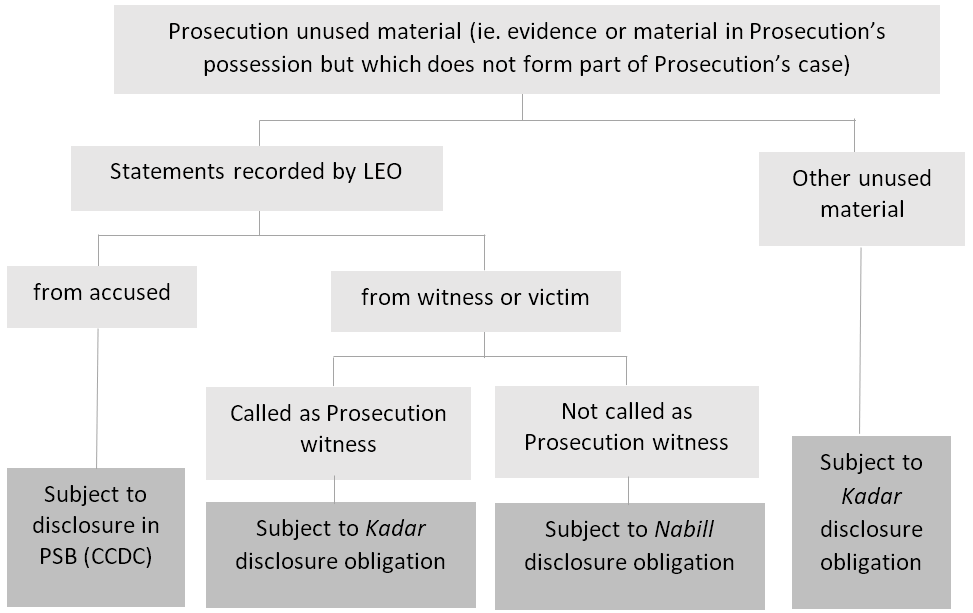
The second component arises from the 2011 Court of Appeal case of Muhammad bin Kadar v PP (Kadar).7 There, the Court held that the Prosecution has a common law duty to disclose to the Defence any unused material it has in its possession, which takes the following form (and which is not already subject to disclosure under the CCDC scheme):8
any unused material that is likely to be admissible and that might reasonably be regarded as credible and relevant to the guilt or innocence of the accused, and
any unused material that is likely to be inadmissible, but would provide a real (not fanciful) chance of pursuing a line of inquiry that leads to material that is likely to be admissible and that might reasonably be regarded as credible and relevant to the guilt or innocence of the accused.
The third component is based on the very recent Court of Appeal case of Muhammad Nabill bin Mohd Faud v PP (Nabill).11 In that case, the Court held that the Prosecution has an additional common law duty to disclose to the Defence a statement (or part(s) of a statement) given by a material witness and recorded by a LEO, where that witness is not a Prosecution witness at trial (Nabill disclosure obligation).12 In that relation, a material witness refers to a witness who can be expected to confirm or contradict an accused’s defence in material respects.13 Disclosure under this obligation should likewise generally take place before the trial begins.14 Prior to this case, such statements would have been governed by the Kadar disclosure obligation.
 For God, Truth and Meaning
Leave a comment